


Weaning Baby With Allergy Risk Safely
- Gary Stiefel

- Jun 11
- 6 min read
That first spoonful can feel far bigger than it looks. For parents who are weaning baby with allergy risk, starting solids is often wrapped up with questions about eczema, family history, previous reactions and whether one wrong step could trigger a serious problem. The reassuring news is that, in most cases, careful and timely introduction of foods is safer than delaying without a clear medical reason.
A baby may be considered at higher allergy risk if they have eczema, especially early or more persistent eczema, if they have already reacted to a food, or if there is a strong family history of allergic disease such as food allergy, asthma, hay fever or allergic rhinitis. Risk does not mean a child will definitely develop a food allergy. It means weaning deserves a little more planning and, sometimes, specialist input.
When to start weaning a baby with allergy risk
Most babies are ready for solid foods from around six months of age. Signs of readiness matter more than the calendar alone. A baby should be able to sit with support, hold their head steady, coordinate eyes, hands and mouth, and swallow food rather than push it straight out.
For babies with allergy risk, current evidence does not support routinely delaying common allergenic foods such as egg or peanut beyond this point. In fact, unnecessary delay may miss an important window when regular introduction can help support tolerance. That said, there are exceptions. If your baby has had a previous immediate reaction, significant eczema that is difficult to control, or suspected existing food allergy, it is sensible to discuss a plan with a paediatric allergy specialist before introducing higher-risk foods.
Breast milk or formula remains the main source of nutrition during early weaning. Solids begin as an addition, not a replacement. This makes it easier to go slowly and observe how your baby responds.
Which foods matter most during weaning
Early weaning often begins with simple foods such as vegetables, fruit, baby rice or porridge. Alongside these, allergenic foods should usually be introduced in an age-appropriate form once basic weaning is under way. The key foods parents often ask about are cow’s milk, egg, peanut, wheat, sesame, fish and soya.
How the food is prepared matters. Whole nuts are a choking hazard and should never be given to babies. Peanut should be offered only as a smooth peanut butter thinned into puree or porridge, or in another safe texture. Egg is usually introduced well cooked. Cow’s milk can be used in small amounts mixed into foods before the age of one, although it should not replace breast milk or formula as the main drink.
There is no prize for introducing everything at once. A calm, structured approach is safer and easier to interpret. Offer one new allergenic food at a time, during the daytime, when your baby is well and you can observe them afterwards. Once a food is tolerated, keeping it in the diet regularly is often just as important as the first introduction.
A practical approach to weaning baby with allergy risk
Parents often worry that they need a complicated protocol. Usually, they do not. Start with a very small amount of the chosen food, such as the tip of a teaspoon mixed into a familiar puree. If there is no reaction, you can gradually increase the amount over subsequent feeds.
Choose a day when your baby does not have a viral illness and when you are not rushing out to nursery, a family gathering or a long car journey. Introduce new foods earlier in the day rather than late evening. This allows time to monitor for symptoms.
Keep things straightforward. If you introduce peanut on the same day as egg and yoghurt, and your baby develops hives, it becomes much harder to know which food was responsible. A little patience early on can prevent confusion later.
For many families, the bigger challenge is not the first mouthful but consistency. If your baby tolerates a food, aim to continue offering it regularly in suitable portions. Long gaps after successful introduction can create uncertainty.
What reactions to watch for
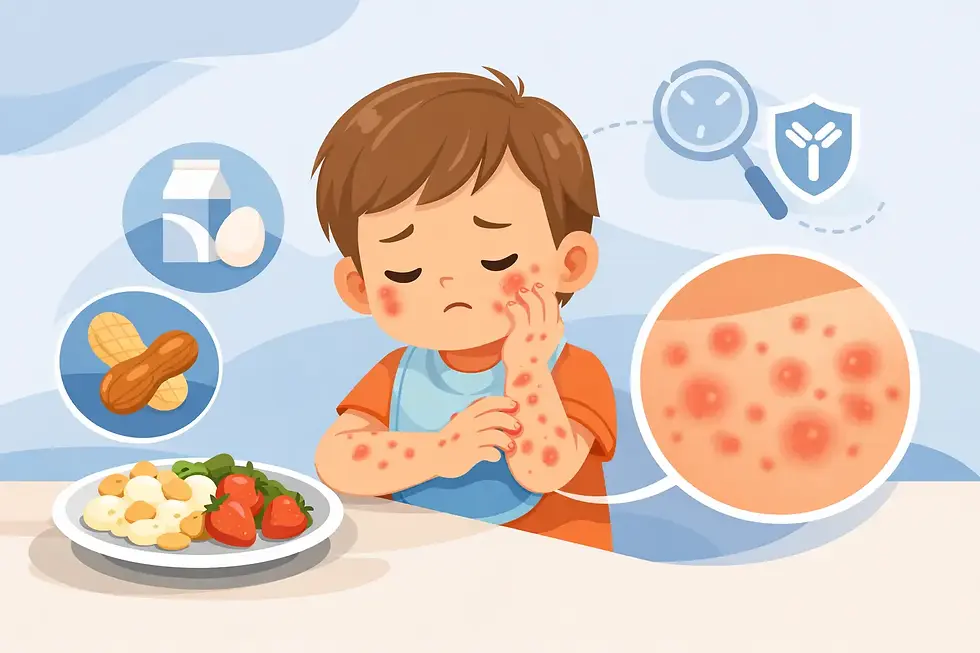
Many babies pull faces at new tastes, and some develop temporary redness around the mouth from acidic foods or simple skin irritation. That is not the same as an allergic reaction. True allergy symptoms typically appear soon after eating and may include hives, swelling of the lips or face, vomiting, sudden worsening of eczema, coughing, wheeze, or marked distress.
Some reactions are mild and some are serious. A severe allergic reaction, sometimes called anaphylaxis, can involve breathing difficulty, persistent cough, wheeze, floppiness, pale appearance or collapse. If these symptoms occur, seek urgent medical help immediately.
Less obvious patterns can also matter. Delayed symptoms such as worsening eczema, reflux-like symptoms, diarrhoea, blood or mucus in stools, or faltering feeding may not point to an immediate IgE-mediated allergy but still deserve proper assessment. This is one reason expert paediatric history-taking is so important. Allergy is not always as simple as a single dramatic rash.
When specialist assessment is sensible
There are times when home introduction may not be the best first step. If your baby has already had a reaction to a food, has moderate to severe eczema, is avoiding multiple foods, is failing to thrive, or has test results that no one has properly explained, specialist review is worthwhile.
A paediatric allergy assessment looks at the whole child, not just one food. The pattern of symptoms, timing, eczema control, feeding history, family history and growth all help build the picture. Skin prick testing or specific IgE blood testing may be useful in selected cases, but results must always be interpreted in context. A positive test does not automatically mean a child is clinically allergic, and a broad panel of tests without a clear reason can create more anxiety than clarity.
Where the history is uncertain, supervised food introduction or an oral food challenge may be the safest and most informative next step. This can prevent unnecessary long-term avoidance, which carries its own nutritional and practical consequences.
Common mistakes during weaning with allergy concerns
One of the commonest problems is delaying all allergenic foods because a baby has eczema. Eczema increases allergy risk, but avoidance without a plan can make feeding more stressful and restrictive than it needs to be. Good eczema management and sensible food introduction often need to happen alongside each other.
Another issue is over-reliance on testing. Parents are sometimes told a food is "allergic" based only on a low-level blood result, even though the child has eaten it without trouble. This can lead to unnecessary dietary restriction and significant family anxiety.
It is also easy to remove too many foods at once. If milk, egg, soya and wheat are all excluded together, it becomes harder to know what is truly causing symptoms, and nutrition may suffer. Babies need enough energy, protein, calcium and key vitamins for growth. Restrictive diets should be supervised carefully.
Supporting nutrition and confidence
Weaning should still be a time of developmental progress and family enjoyment, even when allergy risk is part of the picture. Babies need opportunities to explore texture, taste and routine. Fear can understandably lead to very limited feeding, but this can create a different set of problems around intake, variety and family stress.
If one or more foods must be avoided, families may need practical guidance on suitable alternatives, label reading, nursery communication and what to do if a reaction happens away from home. This is where tailored paediatric allergy advice makes a real difference. The best management plans work in kitchens, cafés, grandparents’ houses and childcare settings, not just in the consulting room.
At Children’s Allergy Cambridge, this sort of planning is a central part of care because parents rarely need information alone. They need a safe, realistic way to put it into practice with their own child.
Weaning baby with allergy risk and older advice
Many parents receive conflicting messages from relatives, social media and older books. Some were told to avoid egg, peanut or fish for the first year or longer. Advice has changed because the evidence has improved. Earlier, structured introduction is now often recommended rather than blanket delay.
That does not mean every baby should follow the exact same script. A child with severe eczema and a sibling with peanut allergy may need a more cautious plan than a baby with a grandparent who has hay fever. This is where nuance matters. Sensible weaning is not about either panic or false reassurance. It is about matching the approach to the child in front of you.
If you are feeling hesitant, that feeling is understandable. Starting solids when allergy is on your mind can be emotionally difficult, especially if you have seen another child have a reaction. A thoughtful plan, clear advice and specialist support where needed can make the process much safer and far less overwhelming.
A good next step is rarely to avoid feeding altogether. More often, it is to prepare carefully, introduce foods steadily, and ask for expert help if the picture is not straightforward.


Comments