


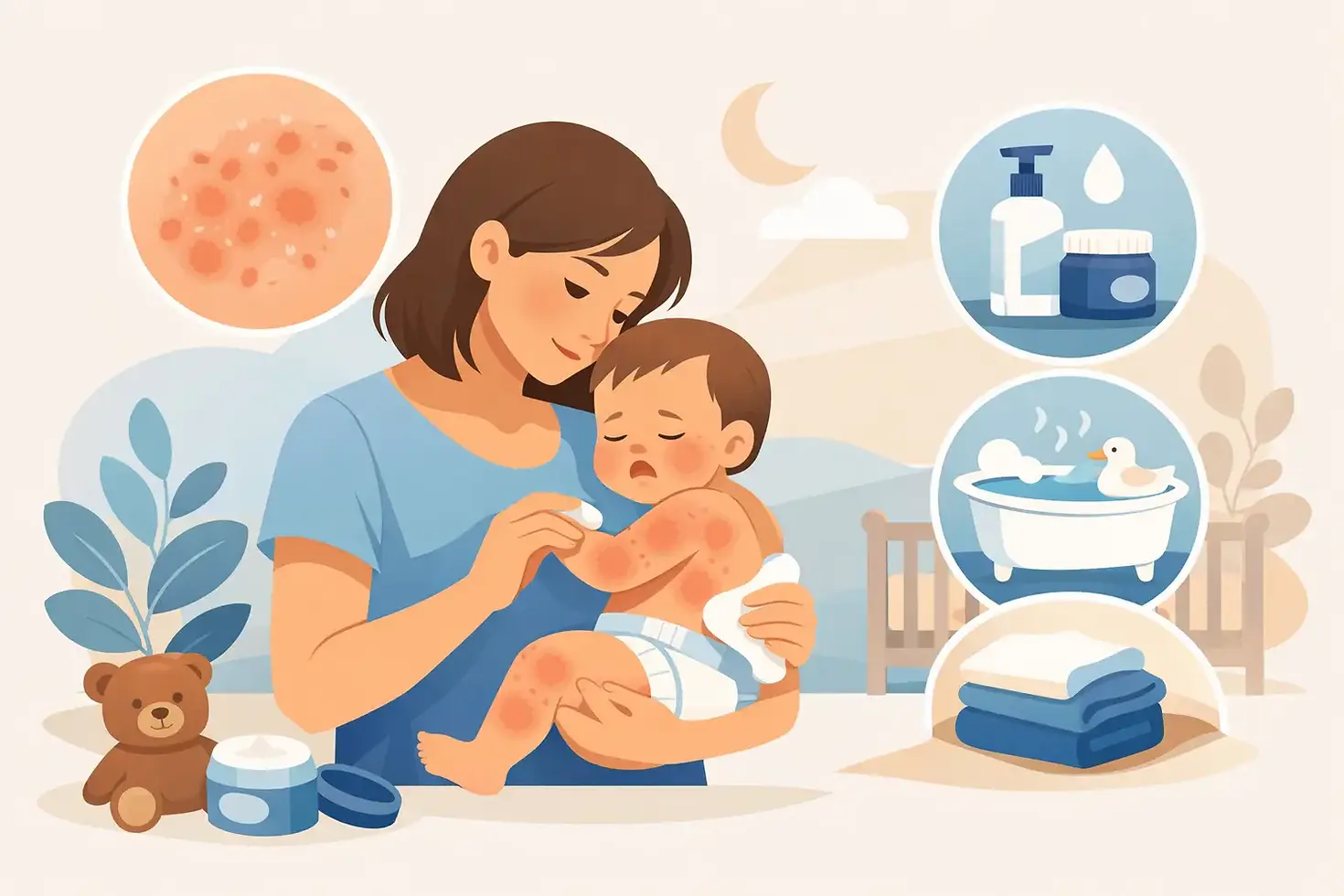
How to Manage Baby Eczema: A Parent’s Plan

A baby who is scratching, unsettled and waking repeatedly can leave the whole family exhausted. Eczema is very common in infancy, but that does not make it easy to live with. Knowing how to manage baby eczema means treating the skin barrier every day, responding promptly to flares and seeking specialist advice when symptoms suggest infection, food allergy or another contributing factor.
What baby eczema can look like
Baby eczema, also called atopic eczema or atopic dermatitis, often begins in the first months of life. Skin may be dry, rough, red or cracked. In younger babies, it commonly affects the cheeks, scalp, trunk and outer surfaces of the arms and legs. As children become more mobile, eczema often appears in the creases of the elbows and knees, around the wrists and ankles, and on the hands.
Eczema can look different across skin tones. Redness may be less obvious in darker skin, where affected areas can look purple, grey, darker brown or ashen. Whatever a child’s skin tone, persistent scratching, rubbing, dryness, weeping or disturbed sleep are useful signs that eczema is active.
Eczema tends to follow a pattern of calmer periods and flares. The aim is not simply to react when the skin becomes visibly inflamed. Regular maintenance gives the skin a better chance to hold in moisture and protect against irritants.
How to manage baby eczema at home
Restore the skin barrier every day
Emollients, or moisturisers, are the foundation of eczema care. They reduce dryness, support the skin barrier and can lessen itch. They need to be used generously and frequently, including when the skin looks relatively settled.
Creams, ointments, lotions and gels can all be prescribed or recommended, but there is no single product that suits every baby. Ointments are often particularly helpful for very dry skin because they contain less water, although some families find them greasy. Creams can feel more practical during the day. The best emollient is usually one that is effective, comfortable for your baby and realistic for your family to apply consistently.
Smooth emollient on in the direction of hair growth rather than rubbing it in vigorously. If your baby needs both an emollient and a prescribed topical steroid, apply them separately, allowing time between applications where practical. Your clinician or pharmacist can clarify the order and timing for the products prescribed.
Keep bathing gentle and brief
Bathing does not need to be avoided, but long hot baths and fragranced products can dry and irritate the skin. Use lukewarm water and keep baths short. A soap substitute or emollient wash may be advised instead of standard soap, bubble bath or fragranced baby wash.
Pat the skin dry gently rather than rubbing, then apply an emollient straight away while the skin is still slightly damp. This simple routine can make a meaningful difference to dryness.
Avoid assuming that “natural”, fragranced or heavily marketed baby products are gentler. Essential oils, perfumes and some botanical ingredients can irritate sensitive skin. Plain, fragrance-free products are generally the safer choice for eczema-prone skin.
Treat inflammation early during a flare
When eczema becomes red, sore, itchy or thickened, moisturiser alone may not be enough. Topical corticosteroids are commonly prescribed to settle inflammation. Parents are understandably cautious about steroid creams, particularly for a baby, but when the right strength is used on the right area for the advised duration, they are an effective and well-established treatment.
Undertreating active eczema can lead to more scratching, broken skin, poor sleep and repeated flares. The strength, amount and duration of treatment should be tailored to your child’s age, the body area affected and the severity of their eczema. Delicate areas such as the face and skin folds need particular care. Do not use leftover creams or another family member’s treatment without medical advice.
If flares are frequent, a clinician may recommend a proactive plan, such as treatment on previously troublesome areas on certain days of the week. This is different from using treatment continuously without review, and it should be clearly explained in your child’s management plan.
Reduce everyday irritation
Heat, sweat, saliva, rough fabrics and detergents can all aggravate eczema, although triggers vary between children. Dress your baby in light, breathable layers and avoid overheating, especially overnight. Soft cotton clothing is often better tolerated than wool or scratchy synthetic fabrics.
For dribble-related eczema around the mouth, cheeks or neck, gently clean away saliva and use a protective emollient barrier as advised. Keep fingernails short to limit skin damage from scratching. At night, cotton mittens may help some younger babies, but they are not a substitute for controlling itch and inflammation.
When eczema may be infected
Eczema-prone skin is more vulnerable to infection. Contact a clinician promptly if the skin becomes weepy, crusted, unusually painful, warm or rapidly worse. Honey-coloured crusting, pustules, spreading redness or a fever can indicate bacterial infection.
Seek urgent medical assessment if your baby develops clusters of painful blisters, punched-out sores, marked lethargy or fever, particularly if eczema worsens quickly. This can rarely be eczema herpeticum, which requires prompt treatment.
Do not rely on moisturisers alone when infection is suspected. A clinician needs to examine the skin and decide whether treatment is required.
Is baby eczema caused by a food allergy?
Eczema is not usually caused by food allergy. Most babies with eczema do not need broad allergy testing or unnecessary dietary exclusions. Removing foods without a clear reason can make feeding more difficult and may affect nutrition.
However, eczema and food allergy can occur together. Specialist assessment is particularly valuable when a baby has moderate to severe eczema that is not settling with appropriate skin treatment, or when symptoms occur soon after eating a particular food. Immediate symptoms may include hives, swelling of the lips or face, vomiting, cough, wheeze or a sudden change in behaviour.
In some cases, food allergy can contribute to eczema flares, but delayed eczema alone is not proof that a food is responsible. Skin prick testing and specific IgE blood tests can be useful when guided by a detailed allergy history. A positive test shows sensitisation, not necessarily a clinical allergy, so results must be interpreted carefully alongside your child’s symptoms and diet.
If an allergy is suspected, it is especially important not to delay or avoid introducing common allergens without individual advice. The right approach depends on your baby’s eczema severity, feeding history and any previous reactions.
When to ask for specialist help
Your GP, health visitor or community pharmacist can support many babies with mild eczema. A paediatric allergy or dermatology assessment may be appropriate when eczema is severe, recurrent, affecting sleep or not responding to a properly followed treatment plan.
Specialist review can also help where there is suspected food allergy, poor growth, multiple dietary exclusions, recurrent skin infection or uncertainty about which creams to use and when. The assessment should consider your child’s eczema pattern, feeding, growth, family history of allergy, previous reactions and current skin care routine. Where testing is needed, it should answer a specific clinical question rather than create more uncertainty.
At Children’s Allergy Cambridge, families are supported with tailored plans that make sense at home and in nursery, including clear guidance on skin care, prescribed treatments, food introduction and when to seek urgent help.
A practical routine that families can sustain
Consistency matters more than a complicated cupboard full of products. Many families find it helpful to make eczema care part of predictable moments in the day: after bathing, before naps if skin is itchy, and before bed. Keep the products you use regularly in one place and ensure everyone caring for your baby knows the plan.
Take photographs during significant flares, particularly if the skin improves before an appointment. A brief record of new foods, symptoms and treatments can also help identify patterns without assuming every flare has a dietary cause.
Your baby’s eczema may take time to settle, and management often needs adjusting as their skin, feeding and daily routine change. With a clear plan and timely review when something is not working, most families can move from constantly reacting to flares to feeling far more confident in their child’s care.


Comments