


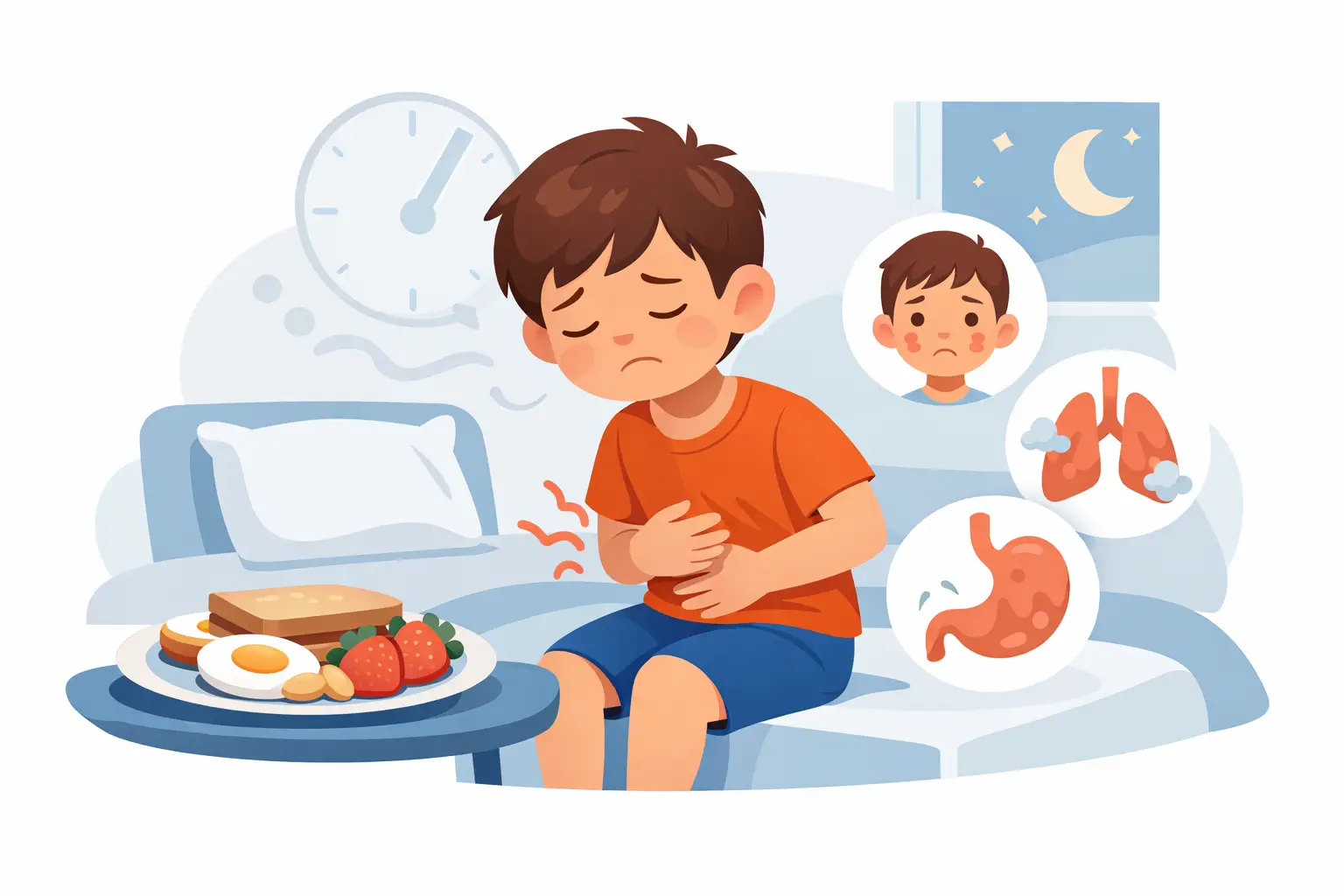
Delayed Allergy Symptoms After Eating in Children

A rash that appears at bedtime after a lunchtime meal, worsening eczema the following day, or repeated tummy pain several hours after eating can leave parents searching for a pattern. Delayed allergy symptoms after eating can occur in children, but timing alone does not prove that food allergy is the cause. Many common childhood illnesses and skin conditions fluctuate naturally, so a careful paediatric assessment is often far more useful than removing several foods at once.
What counts as a delayed reaction to food?
Food allergy reactions are often divided into immediate and delayed patterns. Immediate, or IgE-mediated, reactions usually begin within minutes and generally within two hours of eating the trigger food. Hives, swelling of the lips or face, vomiting, coughing, wheeze or a sudden change in behaviour in a young child may occur. These reactions need prompt medical attention, particularly if breathing, swallowing, circulation or alertness is affected.
Delayed reactions are more often described in non-IgE-mediated food allergy. Symptoms may develop several hours later, or occasionally over the following day or two. They are most often gastrointestinal or skin-related rather than sudden and dramatic. A baby with cow's milk protein allergy, for example, may have persistent reflux-like symptoms, loose stools, constipation, discomfort during feeds or eczema that is difficult to settle. Older children may report recurring abdominal pain, nausea or bowel changes.
The distinction is useful, but real life is not always neat. Some children have a mixture of immediate and delayed symptoms, and eczema can flare for many reasons besides food. The key question is whether there is a consistent, clinically plausible relationship between a particular food and your child's symptoms.
When delayed allergy symptoms after eating need urgent help
A reaction is not made safe simply because it started later than expected. Call 999 if your child has difficulty breathing, persistent coughing or wheeze, a hoarse voice, swelling of the tongue or throat, is pale, floppy, unusually sleepy, confused, or collapses after eating. Use their prescribed adrenaline auto-injector without delay if their allergy plan advises it, then call 999.
Seek same-day medical advice for repeated vomiting after a suspected food, significant lethargy, dehydration, blood in stools, severe abdominal pain or rapidly spreading hives. For babies, poor feeding, poor weight gain or ongoing distress also warrants timely review.
Occasionally, symptoms can return after an initial allergic reaction has improved. This is known as a biphasic reaction and is different from a child developing eczema the next day. Families whose child has had a significant immediate reaction should receive a clear emergency plan tailored to that child.
Symptoms that may suggest a food-related pattern
Delayed food allergy does not have one single signature. In infants, clinicians may consider it where there is a combination of ongoing feeding difficulty, vomiting, altered stools, eczema and faltering growth, particularly when symptoms improve during a structured, supervised exclusion of a suspected food and return on reintroduction.
In older children and teenagers, the picture needs particularly careful interpretation. Recurrent abdominal pain is common and can be linked to constipation, anxiety, viral illness, coeliac disease, inflammatory conditions or functional gut symptoms. A food trigger is possible, but it should not be assumed simply because a symptom follows a meal.
A useful history looks beyond one difficult day. It considers what was eaten, how much was eaten, when symptoms began, whether the food has caused similar problems before, and whether the child was unwell or had eczema, hay fever or asthma symptoms at the time. The form of the food matters too. Baked egg, for example, may be tolerated by some children who react to lightly cooked egg, while milk in a small amount of biscuit is not the same exposure as a glass of milk.
Why testing is not always the answer
Skin prick tests and specific IgE blood tests are valuable tools for investigating suspected immediate food allergy. They help identify IgE sensitisation, meaning the immune system recognises a food allergen. However, a positive test does not by itself prove that a food is causing symptoms. Some children test positive yet eat that food without difficulty.
These tests are also not reliable ways to diagnose most delayed, non-IgE-mediated reactions. Broad food panels can therefore create confusion and lead families to avoid foods unnecessarily. Restricting milk, egg, wheat, soya and other staples without a clear plan can affect nutrition, growth, family meals and a child's confidence around food.
Commercial tests that claim to diagnose food intolerance from hair, applied kinesiology or IgG results should not be used to diagnose allergy. They may identify exposure to ordinary foods rather than a harmful reaction, and can result in restrictive diets that do not address the real problem.
How a paediatric allergy assessment works
A specialist assessment begins with a detailed account of your child's symptoms from pregnancy and infancy where relevant, through to their current diet, growth, eczema, medicines and previous reactions. Photographs of rashes, food packaging and a concise symptom diary can be genuinely helpful, especially when a rash has faded by the appointment.
The clinician will assess whether the history is more consistent with immediate allergy, delayed allergy, eczema unrelated to food, an intolerance, or another medical condition. Examination and growth assessment may be needed. Where immediate allergy is suspected, skin prick testing or specific IgE blood testing may be chosen and interpreted in the context of the history, rather than treated as a stand-alone answer.
For a possible delayed allergy, the most informative approach may be a time-limited exclusion of one food, followed by planned reintroduction. This should be specific, nutritionally safe and long enough to assess change without becoming an open-ended restricted diet. The reintroduction step matters: symptoms that improve while a food is excluded may have improved for unrelated reasons, particularly with eczema or gut symptoms.
Where there has been an immediate reaction or the history suggests a higher risk, families should not reintroduce the food at home. A supervised oral food challenge may be appropriate in a hospital or specialist setting. It remains the most definitive way to establish whether a child can safely eat a food in selected circumstances.
What parents can do while waiting for review
Keep the diet as normal as possible unless a clinician has advised avoiding a food or your child has had a clear reaction. If a particular food has caused hives, swelling, vomiting or breathing symptoms, avoid it and seek medical advice rather than testing it again at home.
For less urgent, recurring symptoms, record meals, symptoms, timing, medications and relevant factors such as illness, teething, constipation or an eczema flare. A record over two to three weeks is usually more meaningful than noting every mouthful for months. Include foods eaten outside the home, nursery meals and ingredients in sauces or baked goods.
Continue good eczema care if this is part of the picture. Regular emollients and appropriate prescribed anti-inflammatory treatment can reduce skin inflammation, making it easier to judge whether food is truly contributing. Avoid making multiple dietary changes at once, as this makes the pattern harder to interpret and can place unnecessary pressure on family life.
Plans for nursery, school and everyday life
If a food allergy is confirmed, management should extend beyond the kitchen table. Parents need clear advice on avoidance, label reading, meals out, birthdays, travel and what to do after accidental exposure. Nursery and school staff should have an individual plan that explains the child's allergen, symptoms, medication and emergency action required.
For children with delayed symptoms only, plans are often different. There may be no need for emergency medication, but there should still be clarity about which foods are avoided, what substitutions are suitable and how reintroduction will be reviewed. Tailored guidance protects the child without making ordinary childhood experiences unnecessarily restrictive.
A well-observed pattern is valuable, but it is not a diagnosis in itself. With a clear history, appropriate testing where indicated and a structured food plan, families can move from worrying about every meal to understanding what their child actually needs.


Comments